Tuesday, 28 January 2014

Hyundai claims car fire in 2010 found no technical fault of the vehicle could account for the incident.

A fire gutted 2010 Hyundai Elantra. Hyundai could find no technical cause 
for this fire according to their letter reproduced below.

More on the 2013 Hyundai Sonata fire. No comment yet from Hyundai Canada. Will they step up to the plate?

by Tom Thorne

It’s been several days and I have tried since last Friday to contact Hyundai Canada for a statement concerning the burnt out Sonata. The first email I sent to them received an automatic response reply which means I know they got it. 

Today I sent another email saying that my follow up story would be incomplete without a comment from Hyundai Canada or from their parent company in Korea. It’s my test to see how good they are dealing with difficult situations. So tomorrow who knows.

Silence seems to be the way many large corporations deal with problems such as this because they know that they could be held liable. The fact is they are liable and their  silence cannot change that. There is an obvious manufacturing negligence in this situation. No one can doubt that it happened. A senior manager at Hyundai should at least say they they are concerned and sorry.

Their warranties have nothing to do with catastrophic destruction of one of their cars by a spontaneous fire. This is not a warranty matter because it is a complete failure of their product after only 26,000 kilometres of driving. Any warranty is nullified by a burnt out hulk sitting in the snow in the wrecking company yard.  There is no fault on the part of the driver only in the manufacturing, sourcing and engineering of this product can be blamed.

The real question is how can any manufacturer of any product that fails at this catastrophic level say nothing? No amount of silence is going to correct it. No amount of shame however nicely expressed can fix this problem. At best any response is an apology knowing that despite an apology they remain clearly liable and accountable for a failed and very dangerous product. The only way to fix it is to ensure that it stops and never happens again. 

Initial compensation should be the entire insured amount paid by the customer for the car. Any losses such as an insurance deductible, loss of personal or school board property should be paid. A set of winter tires for the replacement vehicle in this case should be recovered. All of this would be a nice start. A kind of contrition that indicates concern for the customer’s well being.

And why not? Hyundai is liable for a giant manufacturing problem that could kill people and they need to correct their sourcing, engineering and how they assemble the car in the factory. In the meantime they need to get real and put their customers first despite any torts for negligence and class actions that may arise. That is a start of being accountable.

Below is the text of a letter provided to an owner of a Hyundai Elantra in 2011 destroyed by a fire. Carolyn (she has no last name apparently) representing the National Customer Connect office of Hyundai Motor America says “they can find no technical fault with the vehicle that accounts for the incident.” 

Surely a burnt out car can qualify as a “technical fault” by any standard.  The rest of this letter speaks for itself. The recipients of this letter refused the offer. That means litigation is needed to get Hyundai to step up to the accountability plate.


© Copyright 2014, Tom Thorne, All rights waved for a reblog.


Saturday, 25 January 2014

2013 Hyundai Sonata destroyed by a fire that started in the passenger compartment. Who is accountable?

Fire gutted interior of 2013 Hyundai Sonata. A catastrophic fire 
by any standard. Will Hyundai be accountable?

2013 Hyundai Sonata burns at the roadside. 

by Tom Thorne, Belleville, Ontario, 25 January 2013

On Monday 20 January 2013 my oldest daughter was driving her 2013 Hyundai Sonata from the school where she teaches to pick up her three teenage children at their high school.

Suddenly the car dashboard began to light up. The car began to show signs of shutting down the power train so she pulled over to the side of the road. Nothing worked and her four way flashers would not come on.  Almost instantly smoke began to billow from the back seat. She got out of the driver’s side grabbing her purse from the front passenger seat.

She attempted to open the back doors to retrieve her computer and school student records. The doors would not open. She backed away from the car as it was engulfed in flames. Someone called 911 and the police and fire department from Quinte West were soon on site retarding the fire. The car could not be saved it is a total loss.

At this time it is not known what caused the fire but it is clear that it started in the back seat after a general systems failure.  One thing is certain the fire did not start in the engine. The engine is completely intact as I saw yesterday when I visited the wreckers in Belleville where the car is stored until insurance officials and fire forensic people examine it.

The wrecker company manager told me at the site that they are seeing more and more wiring that is “too thin” leading to seat heaters and other systems. Another employee offered that he knows of other Hyundai cars that have self ignited but not brought to their lot. A quick search of the internet confirms that Hyundai cars have ignited elsewhere. Some of these instances are listed below.

The fact is this one did ignite for no good reason is a cause for alarm. The insurance company is initially offering a replacement value which means that the victim of this situation does not get the full purchase price back. This car had only 26,000 km. so it is worth less from insurance book values. That means the victim bites the financing or price paid difference after only a year of driving.

 American Fire Administration facts from a report covering 2008-2010 indicate one in seven fires responded to are in cars, 86 percent of those fires are in passenger vehicles. Many of these fires (32 percent) are described as “unintentional”.  Sixty one percent of these fires are in the engine compartment. Forty four percent of fires are started by “mechanical failures”. Twenty eight percent of car fires are caused by insulation problems around wires and 18 percent of fires are caused by flammable liquids.

The average dollar loss per car fire to the victim after insurance is about $5,000 adjusting for market values. Per thousand car fires 2.3 percent result in fatalities usually because the fire is a result of a car crash. In this specific Hyundai Sonata case the fire resulted in no deaths or physical  injury but its psychological effects can be deeper especially when the back doors would not open. My daughter keeps thinking about her children caught in the backseat. 

The American government figures on these fires show clearly that passenger cars are less safe than transport vehicles. Sixty nine percent of vehicle fires are in passenger cars, 16 percent in other passenger vehicles such as light trucks. Non commercial fires on the road account for 86 percent of the fires reported versus seven percent for transport vehicles. Naturally there are more cars than transports but the fire safety of these cars on the road is still 32 percent of fires not caused by a crash.

The remedy for these “unintentional” car fires seems to indicate a tort court action if the drivers of these lemons are to make an impact on the car building industry. There is no excuse for a system failure where wires overheat create a fire and destroy a new car. Clearly there is negligence here in the engineering, sourcing and quality control when these cars are built. That negligence is clearly the responsibility and accountability of the car manufacturers and even those who wilfully offer and sell them to the public.

Please comment on this story with your own car fire experiences at this email or below: thorne.ejournal.tom@gmail.com


The engine was not burned only the interior of this 2013 Hyundai Sonata.
What could cause such a fire?  

Some examples of similar experiences from a simple Google search “Hyundai Sonata fires”:

1. Rocco Feb 2013: As a fire investigator, I have just examined 2 car fires in a week due to electrical failure...2012 sonata-2013 sonata. Coincidence? I think not. Someone in the auto industry needs to look into this.

2. MICHELLE Jan 18, 2014 9:03:16 AM
I had fire 2012 hyundia sonata -- burned on side of hwy -- electrical problem??

3.Another Hyundai Sonata taxi catches fire on expressway - 08May2012 youTube

4. Hyundai Sonata GLS: My 2011 Hyundai Sonata caught fire on my
Resolved Question:
My 2011 Hyundai Sonata caught fire on my way to work this morning. Now it is a total loss. I had an oil change 1 week ago. What do you think may have happened?

5.The vehicle was a 2011 Hyundai Sonata. The VIN of the car is 5NPEC4AC7B_. Upon pulling out from a stop sign the engine stalled, after coasting to a stop and placing in park I tried to restart engine. All lights went off and motor did not turn. Attempted again, same thing then passenger compartment filled with smoke. Fire dept arrived and determined somewhere in dash a component had fried. They then disconnected battery. Vehicle was towed to dealer, per dealer engine locked up and they have to disassemble dash to determine what had fried. This issue happened on Tuesday, September 6, 2011.

6. The car is a 2009 Hyundai Sonata. Vehicle identification number (VIN) of the vehicle is 5NPET46C89_. I started my car and as I started to turn the steering wheel so I could pull out of the parking space smoke spewed from my dashboard. I looked up under the dash and noticed the wiring harness in flames. I extinguished the fire. I then had the car towed to a Hyundai dealer. They examined the damage and said tat it would cost me $4000 to repair it as I needed a new wiring harness. Hyundai claims it wasn't a manufacturers defect, even though the car was purchased brand new and therehas been no alterations or modifications, the same wiring harness is used in kia which has a recall on a wiring harness. I am in possession of the burnt harness and it clearly has kia written on it. This problem occurred on Oct. 1, 2010.

7. On my way home my 2011 Hyundai Sonata caught fire under the
Customer Question: On my way home my 2011 Hyundai Sonata caught fire under the hood. I just had starter replaced 3 days earlier. Received paper stating all is good with my car. What could have caused this fire?

8. wemakeitsafer.com › Recalled Products › Vehicle Recalls › Hyundai
Find recall information for Hyundai Sonata Recall and other recalled cars, trucks ... year 2012-2013 Hyundai Sonata passenger cars, manufactured from January 24, ..... IN THE PRESENCE OF AN IGNITION SOURCE MAY RESULT IN A FIRE.

9. Hyundai Sonata Engine - 2013 HYUNDAI SONATA Problems With ...
www.arfc.org/complaints/2013/hyundai/sonata/engine/problem.aspx
2013 Hyundai Sonata problem with Engine. 2013 ... AN INDEPENDENT INVESTIGATOR STATED THE FIRE ORIGINATED IN THE ENGINE COMPARTMENT.

10. 2011 Hyundai Sonata Electrical System Complaints
www.aboutautomobile.com › Complaints › 2011 › Hyundai › Sonata
Provides Information about 2011 Hyundai Sonata Electrical System Complaints ... On 10/29/2013, 10/30/2013 and 11/01/2013 it began do do the exact same thing. ..... 40 minute with my family inside the vehicle, the left front side caught on fire.

11. My new hyundai sonata 2013 purchased in nov was parked in my ...
www.justanswer.com/.../7ymxz-new-hyundai-sonata-2013-purchased-nov-...
My new hyundai sonata 2013 purchased in nov was parked in my friends driveway for over 4 hours and spontaneously the engine caught fire. It was not arson it ...

© Copyright 2014, Tom Thorne, All rights waved for republishing or a reblog.


Friday, 10 January 2014

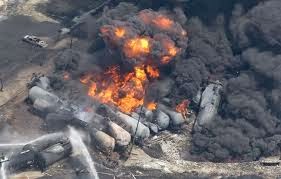
Volumes of rail shipped crude oil are increasing. How can safety be assured when railways often pass through downtowns? Answer: They can't.

Lac-Megantic Quebec: The mother of all railway derailment fires.

Railways passing through urban areas routinely carry noxious hazardous flammable goods each day. Can the rail infrastructure and rolling stock be properly maintained for these increased volumes? Are the trains properly manned to ensure safety?

by Tom Thorne

When the Canadian Pacific Railway (CPR) connected Canada and its vast territory in the late 19th Century they didn’t carry hazardous goods of much consequence. Perhaps the worst thing they transported was wagon axel grease, coal oil and barrels of tar.

Now trains regularly carry noxious crude oil, naphtha and a host of other industrial chemicals most of which can ignite in a derailment to cause large fires and ecological damage. The trouble is they carry these hazardous products through many urban areas that have expanded since the railway was originally built.

In the case of my town, Belleville, Ontario, Canada, the CPR still follows a course from when this railway offered a now defunct passenger service. In the early days it also served some factories downtown. We now have an industrial park on the top of the city that is served by the Canadian National Railway and has access to the major Highway 401 that spans the Province. However the CPR railway still dips down to roll right through the centre of town paralleling the Bay of Quinte where we draw our drinking water.

In addition, on its way down through town it is less than 100 meters at most from the back of our General Hospital. If we had a fire the size of Lac-Megantic, Quebec, near our hospital it would be rendered unusable and all the patients would have to be removed and housed elsewhere unless they were consumed by the flames. Also we would have no hospital medical service for the duration of such a disaster should it occur. 

My house in the west end of Belleville and is about 300 meters from the CPR track.That’s close enough that if we had a Lac-Megantic size fire for me to abandon my home for safety after helping hopefully to pull patients out of the long term care home at my corner. They are 150 meters from the CPR track.

Fortunately I could retreat to one of the three homes of my daughters. I have an acquaintance whose old wooden house downtown is 30 meters from the CPR track. The tracks at his location heave and sway each time a freight train goes through the city. Our downtown could be on fire very easily and our waterways polluted into the bargain because of the bridge that crosses the Moira River at that point.

A few years ago we had a derailment just east of Belleville that took a week to correct. Some of the oil leached into the ground but fortunately did not ignite. During that period the CPR routed its goods traffic through town using the Canadian National Railways (CNR) lines which also run through town but more safely through a larger rail yard. A derailment at this site would be more manageable but it also runs through town to the west and east with double track after leaving the rail yard.

Then this week we had another fiery derailment in Plaster Rock, New Brunswick and a few weeks ago we had another one at Casselton, North Dakota which also burst into flame and forced the evacuation of 2300 people.  Earlier on a stretch of track 86 km from Edmonton, Alberta 100 people were evacuated after a CNR derailment.

It is surely not rocket science to figure out that more and more flammable products are being shipped by rail to keep up with the demand mostly for oil that comes from the Canadian and the American west. The problem is our rail infrastructure and the nature of the rail car designs are prone to accidents of catastrophic proportions as the fiery death of 47 people shows in Lac-Megantic.

Canadian winters play havoc with our aging rail systems. The extreme cold this winter can affect the performance of the rail cars, switches and tracks.  As we have seen with the spate of accidents last year and the beginning of 2014, the system is clearly not safe enough. No amount of clever public and media relations or nice words from railway executives and government politicians can make this problem go away.

Since last May we have had ten serious derailments in Canada that are documented. Many other small problems go unreported especially by media. Every CPR goods train that passes through my town each day carries the potential for devastation. Some believe that the solution lies in pipelines. Pipelines in our area are aging like our rail system and the one that passes north of Belleville crossing watersheds. They are  destined for more volume to send crude oil to Montreal for refining. 

And can we expect that the Obama government is going to allow Canadian pipelines to enter the US in the near future? The answer is that the Congressional agenda in the United States has placed these pipelines from Canada on the political back burner. The Harper government wants to send our Alberta crude through pipelines to the BC coast and to Montreal. However in the meantime it will roll past our doors in increasing numbers of trains over track that needs attention and in cars that are single hulled and prone to ripping open in a derailment.

Each time I hear the train horns passing through my town I say a prayer first to remember the dead of Lac-Megantic and secondly to preserve us from a catastrophe at the end of my street.

© 2014 Tom Thorne, All Rights Reserved.


Monday, 30 December 2013

Political thoughts while chipping away at the Ice Storm...


Politicians and the New Year. Depressing thoughts as I chip away five centimetres storm ice from my driveway.

by Tom Thorne

We are one day away from the New Year and the start of 2014. I would like to begin this new year on a positive note but despite my desire to remain positive I sadly drift into negativity. Each time I think of our politicians and their lack of leadership in this country I begin to despair for our future.

They feed us pap, and they utilize Facebook and Twitter snippets so they don’t have say very much. Their newsletters for their ridings are bland and one sided and there is a ruse that they want your opinions for matters that ordinary members of parliament have no control over without a Prime Minister’s Office nod. 

They live in a world of soundbites and try to ruin each other’s reputations with attack advertisements. They talk about action plans, balancing budgets, but only answer questions and concerns in vague and evasive ways. Harper government ministers are noted for their lack of response to media questions and public concerns.

They wrap the parliamentary legislation into omnibus bills that are so opaque that they defy analysis even by their own caucus and need hoards of overpaid bureaucrats to unravel whether new funding or some pile of unspent dollars is now finally being applied.  

The Harper government uses unelected staff to interfere with Parliament and the Senate. Members of Parliament are expected to vote on issues like trained seals although there is a flickering of hope on this front with some reforms in a private members’s bill.

In all of this there is little evidence of responsibility or accountability and leadership is no where to be seen unless it is implementing Star Chamber methods that smack of tyranny to get rid of or suspend without pay allegedly miscreant senators who fall foul of the Prime Minister. They deny of due process and political expediency is their modus operandi.

The upcoming year portends a bleak prospect of preparing us for the 2015 federal election. Every effort will be made to balance the budget by 2015 for the first time in years by cutting back everywhere. This debacle masquerades as sound fiscal management in the eyes of the Harper right wing ideologues who must now play to their “base” of right wing supporters to get re-elected.

My despair may of course may be brought on by our recent Eastern Canadian ice storm that has left us in a state of frozen greyness when there is no sun for many days. The prospect of a hard winter combined with the usual political ineptitude in Ottawa is enough to drag one into a state of despondency.

Usually at this time we think of our upcoming winter visit to Cuba but this year we are stuck here because of other commitments to the travel budgets later in the Spring. So I despair as I read the Globe and Mail each morning and then watch people trying to forget the greyness by attending the Boxing Day sales in an attempt to remove bleakness from their lives with an Xbox 4 purchase.

The last thing on the public’s mind at this time of year is further information and revelations about the Ottawa crowd. On TV news shows their political debacles are incessantly reviewed as the big stories of 2013. It’s depressing how what purports to be news has sunk so low. No wonder people retreat into games where armed avatars in Call of Duty can unleash violence and mayhem and destroy bad guys. 

Perhaps a new game could be devised and named Recall Ottawa. In this game if politicians fail to lead us or answer questions directly and honestly, the Kraken from Fall of the Titans is released to deal with them. If they bad mouth a political opponent they are subjected to a fiery hell where attack ads about their lies and ineptitudes are played to them for eternity.

Sadly such justice fleetingly passes through my mind as I chip away at five centimetres of ice on my sidewalk.


© Copyright 2013, Tom Thorne, All Rights Reserved

Thursday, 26 December 2013

The Harper Government sees social programs as cost items not investments. The Canada Pension Plan payouts and Old Age Security create economic activity.

Federal Finance Minister Jim Flaherty: The Harper Government's 
re-election hope and chief fiscal ideologue 


The economics of the federal Canada Pension Plan  (CPP) and Old Age Security (OAS) programs are in the news. Below is a modest proposal to rethink these programs not as costs but as creators of economic activity.

The economy is not as “fragile” as federal Finance Minister Jim Flaherty says it is. There is good evidence for a US recovery.  It’s the 2015 election prospects for the Harper Government and the political need balance their budget that holds Flaherty back.

One of the biggest Canadian (in fact North American) demographic groups are Baby Boomers turning into ageing geriatrics. They are now and into the near future actively drawing pensions that some of them have built up working for the private sector and governments. 

Many others, however, are relying on the federal public purse. They have no savings or pensions  except The Canada Pension Plan (CPP) and Old Age Security.  Although they work often at two or more jobs they have not the resources to save for retirement. This demographic cadre is still growing as a percentage of the total Canadian population and many may have difficulty supporting themselves in old age unless changes are made.

All Canadians with an employment record have assets being paid out from the CPP and most Canadians draw the Old Age Security and those with lower incomes the draw the top up Income Supplement amount. Too many Canadians only have these federal programs in their old age and so hover on or live in poverty. The Provinces want to increase the premiums and the payouts of the CPP.

A week or so ago federal government Finance Minister Jim Flaherty met with provincial governments to discuss what should happen to the CPP in the near future. Many provinces in Canada want to build up this fund with escalating premiums shared equally by employers and employees increasing contributions over a reasonable time to ensure that those without work place pensions have enough or at least more money in their old age. Their ideas also include provisions so employers don’t see CPP increases as killers of business opportunities.

Ontario is particularly inclined to do this but Jim Flaherty said at the Meech Lake meeting that the economy is too fragile to take increases in premiums to build up a CPP with better payouts.  Since the CPP and Old Age Security are federal programs this means that the Stephen Harper Government has decided to do nothing. The provinces are unamused. The current Harper government may have lit the fuse of a social and political time bomb. 

I have a different view of the CPP and Old Age pensions provided by the federal government. I see these programs as net increasers of economic activity. Without them the economy would be greatly curtailed. Let’s look why that is.

The federal government can create money supply by printing what my laconic Estonian university economics professor called “Queen’s pictures”. During my brush with two economic courses back in the 1960’s the one dollar and twenty dollar bill had pictures of the Queen on them. Hence the name “Queen’s pictures”.

Currency printed on paper (or now that new dreadful plastic material) they only work because we accept them as a medium of exchange. They are worthless if the recipients say they are. In early Russian post Soviet currency markets Canadian Tire dollars were accepted as representing one Canadian dollar equally well as the real thing.

Today we accept the Canadian dollar, the Euro and the US dollar and the low pegged Chinese Yuan as useful and their relative values to one another make up an economy for the world. However the brutal truth of this situation is they are valued because they are accepted even when they are stressed by crisis like European countries recent near defaults and later the USA nearly defaulting on their national debt ceiling.

Now this is along way of saying that the government of Canada and other national governments create money by issuing pretty bank notes. Another way they create money is by issuing cheques that can be exchanged in a bank account for Queen’s or Prime Minister’s pictures. Whether you use your debit card or use pretty bank notes they create economic activity with nothing to back them except your belief that the system works for you and others.

It is my contention that CPP and Old Age cheques or electronic impulses sent to banks make a credit in your bank account that you can spend. These programs are wealth creators and they stimulate the economy when the money they create is used or distributed for goods and services. Most recipients of these programs tend to spend all of these value creators each month.

When Finance Minister Jim Flaherty says that the economy is too fragile I really don’t understand. Government currency printing and the issuance of cheques for the CPP and Old Age create economic activity. And the CPP is backed by employee and employer contributions.  Therefore it is possible to increase the contributions and the eventual payouts for these programs if it is carefully phased in over five years or so. In addition, when these federal government sit as a deposit in a Canadian chartered bank they can be lent out at a ratio of better than seven to one and that is really money creation.

Today business has pent up capital that sits in low interest investments waiting to be put to work. Jim Flaherty says the economy is fragile and it is because new business investment is tardy after the melt down in 2008. However in 2013 we are at the five year point and time and an economic breakout is in the air. The economy is as fragile as the Harper Government’s inability to risk anything on the cusp of the 2015 election. For them good fiscal health is their re-election prospects and so they are cutting back to look like responsible stewards of the economy after years of spending.

What is Jim Flaherty afraid of doing to the economy? First the CPP is solvent because it is a fund that constantly gets money paid into it. If that money is increased through higher employee and employer contributions the fund will grow. If self-employed people are also allowed to contribute that will also further build the fund for the future.

Young people saddled with educational debt and doing McJobs are a real drag on the economy and don’t build much equity in the CPP because minimum wage earners probably contribute at minimum levels. They are underemployed and often in jobs with no prospects or pension building opportunities. We need a radical look at how we fund post secondary education and put youth to work after graduation. 

Student loans are a poor idea. This money should not be loans.  These funds should be seen as an investment in human capital and the Canadian economy. The current funding of post secondary education or trades training is frankly set up as an economic negative with a low percentage going to grants.  

Vicious bureaucracies go after payment from new graduates within six months. Four years of post-secondary study can mount $30-40,000 of debt. The result is new grads take crappy jobs to keep money coming in. In expensive cities like Toronto GTA and Vancouver it is almost impossible to get out of the economic hole created by these student loans and it is just as bad elsewhere in the country. Let’s rethink this situation.

In my plan young people who are acceptable and perform well at a college or university get paid a grant each month. The university or college gets a portion electronically each month for its tuitions and operating costs.  The students get a living grant which is enough to live very carefully. If students want a larger lifestyle they fund it themselves or work part time. Parents who can contribute are encouraged to do so by generous tax incentives much better than the current tax credit percentage. This parental or grandparent tax advantage only lasts for four years per student.

Student needs are seen by stupid government bureaucracies and politicians as a debt. If the heat was taken off repayment and that repayment was seen as an increased CPP contribution, then we would be doing something in this country that recognizes that cheques cut by the federal government is the first stage of currency circulation creating economic activity. For the Harper ideologues this would be seen as rampant socialism. I argue that it is not socialism in the context of a knowledge-information society.

The funding of education as much as a CPP retirement and later the Old Age Security funds should be seen as generators of money circulation and economic health. They should not be debits for anyone if attitudes can be altered from the status quo and removed from the relocation prospects of short sighted politicians and bureaucrats. 

When we see BitCoin starting a web virtual currency I argue that governments have been doing this for a long time with CPP and OAS electronic impulses building credits at  Canadian Chartered Banks for their depositors and customers.

© Copyright 2013, Tom Thorne, All Rights Reserved


Friday, 13 December 2013

Political correctness now extends to any alleged objectionable tone of your voice. This stuff has a high Silliness Quotient.


Political correctness is narcissism when a tone of voice can be objectionable.

by Tom Thorne

The other day on the radio I heard an interview which caused me to reflect on political correctness and its place in our daily lives. A woman was on air talking about individual rights when she suddenly said to the radio host that she detected a tone in his voice that she found objectionable.

She forced the issue to the point where the radio host, mostly to retain any kind of decorum, apologized for his alleged negative tone of voice. The woman was quite strident and from her point of view she detected a pejorative tone.

My instinct was to confront her rudeness because her tone was certainly obnoxious and insulting to a very professional radio host. My first response to this woman’s rudeness was shock. Her confrontational tone was alright but the alleged tone of the radio host was not. It was one sided and in my view, did not deserve any apology.

And even when she got an apology she continued with her tone to hammer home her problem with the radio host never defining the problem she had with his tone. Eventually the on air host cut her interview short and called for a station break. She was right and he was wrong there was no ability to interact with ideas and certainly not discuss her views about tone of voice. Narcissism raised its self-centred head. Hopefully when off air he confronted her rudeness.

This kind of ardent political correctness seems to becoming more prevalent. It seems that some individuals must interface others and society only on their terms. There is no restraint or give and take. If a practitioner of this kind of lifestyle discovers something they consider to be objectionable they can unleash a torrent of rudeness which of course they consider to be alright because they are correcting a wrong from their perspective.

Well in my way of thinking this is rampant narcissism. Almost anything anyone can say can be deemed objectionable if tone is used as a measure. Where would such a social convention come from? Why does the individual trump normal social convention? Why are we allowing individuals to declare something objectionable and force apologies when they are not needed?

When the focus is only or primarily on me, then how I define the world is only in my terms. I am frankly loath to understand the social origins of such a notion. In my view it is a type of fascism. Everything is defined in the terms of the person or groups with a political correct ax to grind. It is my way is the only way.

Of course we all know life doesn’t work like this but these politically correct narcissists think that what they sense or understand is always right. This must be a simple self-focused way to live. Imagine saying that you are always right. My perceptions are always the right one. My views are the correct way to think. 

That kind of view of social interaction when it becomes political is in my view a branch of fascism. It defies logic, facts and basic social conventions. It’s the kind of idea that gets concentration camps and political re-education camps built. It can turn ugly and become persecution very fast.

This type of thinking does not engage in dialogue or interchange ideas. It is by its nature anti-democratic. It is also anti-intellectual because it shuts out other ideas by putting up road blocks that are defined as too objectionable to discuss including someone’s tone in their speech. 

Even in the case of the radio host he asked the woman to tell him what was objectionable in his tone asking her questions. She was unable to tell him what he had allegedly done wrong. However, she stayed on the attack saying that in her view his tone was by her personal standards deemed objectionable. 

The origins of this type of thinking are old. They are the same as people who deny evolution or even a discussion of the topic in schools. The viewpoint they present is fixed. It is a literal interpretation of the Bible that says the Earth is 6000 years old. It is the Nazi view that Jews are responsible for all of Germany’s post World War 1 ills. It is the mentality that can devise the Final Solution. It is personal censorship.

It is a world of guilty where innocence has no equity or value. It is prejudgement and it can only come from advanced self absorbed narcism. To use their own type of language, these people are listening to discussion and ideas challenged.

© Copyright 2013, Tom Thorne, All Rights Reserved.


Tuesday, 10 December 2013

Justin Trudeau must begin soon to build Liberal credibility with a solid policy book. His charisma needs substance to unseat the Harper Government.

Justin Trudeau rises in Question Period. 
It will be hard to dislodge the Harper Government in 2015.


What Justin Trudeau has to do.

by Tom Thorne


Justin Trudeau has been basking somewhat in a positive image since he became Leader of the Liberal Party.  Not that he has had nothing to say about Senate scandals and the Prime Minister's Office (PMO) debacle but really he has mostly remained sanitized and above the fray. Even his views on marijuana have given little ammunition to Conservatives or NDP opponents except a few sneers in attack advertisements.

As the PMO scandals develop and Prime Minister Stephen Harper begins his potential descent from power, it seems that tedium is setting in.  New Democrat (NDP) leader Thomas Mulcair, mounted scathing attacks in Question Period holding the Prime Minister's feet to the fire, but his jibes and jabs have not increased NDP popularity nor fully damaged the Harper Government.  

Justin Trudeau on the other hand has increased Liberal votes and popularity in the recent by-elections. So when Thomas Mulcair tried his jabs and jibes on Justin Trudeau they also have had little effect. Justin Trudeau just keeps positively rolling along without really doing or saying too much. Both the Conservatives and the NDP can't really touch Trudeau's current political mojo. He seems to be surrounded by an invisible shield.

This is all very nice for Trudeau but now to really build on his positive image Justin Trudeau and the Liberal Party have to come up with more substance about how they can present an alternative to the Conservatives while at the same time knocking the NDP off Official Opposition status in the House of Commons.

It is my contention that the NDP seats in Quebec are soft and that they will not go in 2015 to the NDP as easily as they did last time. In addition, the current Parti Quebecois polls indicate that the public has no appetite for nationalism or separatism.  

It's bread and butter economic issues that matter in Quebec as they do in the rest of the country. Conservatives even with a decent economic record show no promise in Quebec when the party remains in the hands of right wingers following the Stephen Harper brand.

Therefore it can be time for a Liberal resurgence in Quebec and with a good performance in Ontario and British Columbia the worst outcome is that Liberals form the Official Opposition in 2015 to a minority Conservative Government. 

If something happens to take Stephen Harper off the Canadian political stage (the Senate Scandal, PMO implosion with RCMP charges leading to the PM, a Conservative caucus rebellion, or a run in with party big wigs) then the gloves are off in 2015 because the Conservatives could be rudderless even if Stephen Harper went another round because there would no time to replace him in time. Of course I could be wrong on this one if the Conservative Party brass see a longer future for Stephen Harper as leader.

There will be an general election on 19 October 2015 no matter what happens. To utilize the time leading up to the election what should Justin Trudeau and the Liberal Party be doing? First Justin Trudeau has to stop giving the Conservative propaganda machine fodder for its work. You know that in 2015 Trudeau will be in attack ads for his marijuana statements and his comments (out of context) about the Chinese government. 

And although Trudeau gave his seat on the VIP plane for Nelson Mandela’s funeral to Liberal MP Irwin Kotler, who worked as a lawyer to get Mandela freed, I can see  Conservative attack ads in the 2015 election using this as further Trudeau destruct fodder.

The Conservatives will try to show that Justin Trudeau is a lightweight unworthy to become Prime Minister or even the Leader of the Opposition. How do the Liberals counter this stuff? 

A sample of Harper attack ads to discredit Justin Trudeau. 
The Trudeau name and charisma will not be enough to counter this stuff.

One strategy is to ignore it and let it happen hoping that the vitriolic content of such attacks blows back on the Conservatives. Sadly however, these type of attack ads seem to work. With their current record in the PMO and the Senate, the Conservatives must go on the offensive attacking Justin Trudeau’s considerable threat. 

Trudeau now needs to break out with policies for the next election that create hope of for youth unemployment and education debts. He needs to court the vote of disenfranchised youth and marshal them for the Liberal cause.  

They need policy to stem the industrial decline of Ontario and Quebec and get a more entrepreneurial set of policies that will encourage private pent up capital to start working again to build business. That will require confidence in the business world that seems to be fence sitting for the moment concerning new investment. 

Harper has not been able to get business to increase investment in new plant and machinery or start hiring for real jobs. The Ontario loss of the Heinz plant in Lemington and today the Kellogg factory in London sadly demonstrate that Central Canada's economy is not robust even with a lower dollar and continuing low interest rates. We could well ask what Harper is doing to stem this decline in Ontario.

A Liberal government must also show how they would get Canada back on the International stage as an honest broker and country that can be relied on to look after the global environment. We should be showing leadership on all international forums on these issues. At the moment we have lost any initiative on climate, pollution or convincing the world that we can move tar sand oil safely to markets.

The Liberals have an opportunity at this time to really provide alternatives to Conservative Party right wing notions about prison reform, gun control, and law and order issues.Judges are beside themselves deciding how they can implement mandatory surcharges of $100 per sentence on miscreants who have been found guilty even a first offence for minor crime. This is the result of Harper's tough on crime views in legislation. Poor people pay.

The Liberals need to fully articulate how they intend to give a fiscal break to middle class people. They need to have a war on poverty in Canada and especially among native people. Seniors need to be addressed with how they can preserve retirement savings and make a decent return on their investments.

If Justin Trudeau's Liberals articulate a bright future for Canada then they have an excellent chance to form a government in 2015. The status quo we now have is a downer with secretive leadership. It is full of obscuring of facts, tight controls of the Harper PMO over parliament, cabinet ministers and their ministries. 

Trudeau and the Liberals can contrast a better more positive way for Canada but they need to announce this very soon knowing the fight will be tough countering Conservative promotions featuring distain, ridicule and contempt. The recent attack ads concerning Justin Trudeau as a lightweight even before the election begins, demonstrate the anxiety the Harper Government has about Justin Trudeau.

The Conservatives have the funds to do this negative campaign before the election. Liberal spending should not try to counter these ads. It should take a higher road and show Canadians that there is light at the end of the Harper tunnel. The Liberals have this advantage to counter the Harper view of Canada. 

The Liberals are far enough away from their own peccadilloes to break out. It will be a hard test of whether Justin Trudeau has the right stuff to weather negative attacks while putting forth a positive political that Canadians need to hear.

© Copyright 2013, Tom Thorne, All Rights Reserved